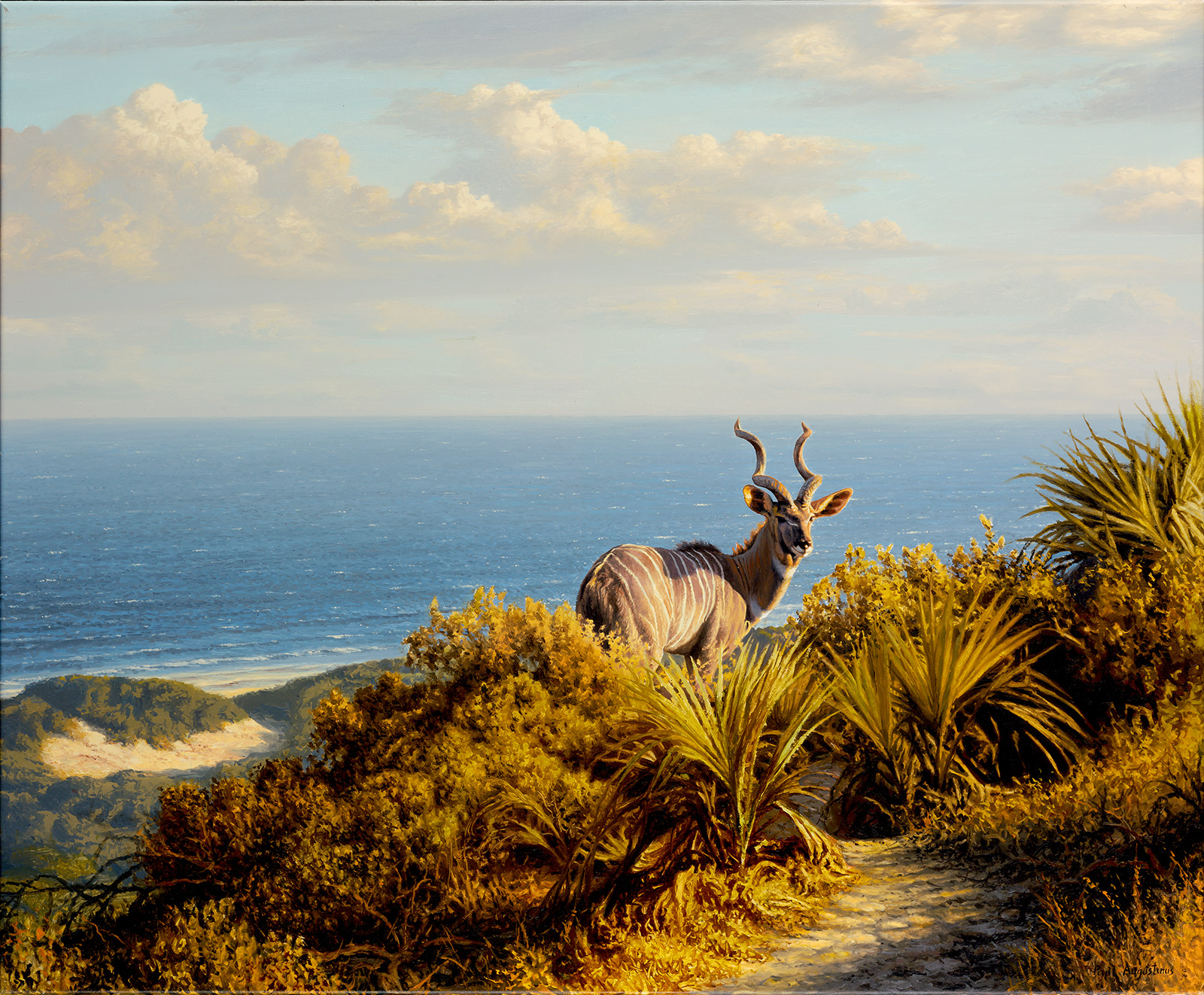
ARTIST: Paul Augustinus
TITLE: The Swahili Coast near Somalia
SIZE: 24in x 31.5in
Oil on Canvas
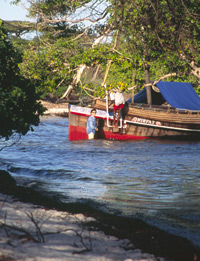
'For several years Clarissa and I would travel to Lamu on the Swahili Coast to rent a jahazi dhow and its crew for a few days, loading it up with our equipment and some of my art supplies, then sailing up the coast towards the Somalia border. The coast and islands north of Lamu are all interesting and what’s amazing is the fact that the hinterland and some stretches of the coast have relic populations of wild (albeit very shy) animals, a consequence of the presence of Somalia bandits and the proximity to the Somalia border. The whole area has the aspect of frontier ‘Outlaw Country’ by virtue of its lawlessness. But it is the old Arab influence, the numerous ruins and the whole Swahili Coast atmosphere and history that makes the existence of these wildlife populations fascinating in a very romantic way. This area of Kenya, from the Tana river delta to the Somalia border, is Kenya’s last secret wildlife area.
Take a dhow north of Lamu through the Manda channel and you pass an ancient crossing place for elephants intent on swimming to Manda Island. West of Kiwayu, which is occasionally visited by lions who swim across from the mainland, which lies on a hundred yards away, there is the vast uninhabited acacia scrub and Dom palm forests of the coastal strip. Here there are herds of buffalo, a few elephants, lots of giraffe and plains game. In 1960 my father, who was en route to Kiunga by boat, came across an elephant mid-channel which was being attacked by sharks.
Surely the whole purpose of a safari is to get away from other people, rather than be stuck in a vehicle with a whole bunch of tourists watching lions hemmed in by a semicircle of mini-buses. That’s the unwanted opposite of a safari on your own by dhow along a coastline lapped by warm blue seas. If you know where to go, you can walk along beaches with lion tracks on them, or hike over a sand dune covered in Dom palms in search of lesser kudu. You might never see the wildlife that exists here, but you will see the signs they leave behind. Above all you will be completely on your own - and that’s all that’s important to me. This painting is of a kudu I briefly saw on a high dune north of Kiwayu.'
To watch the Dhow Safari video go HERE.
.