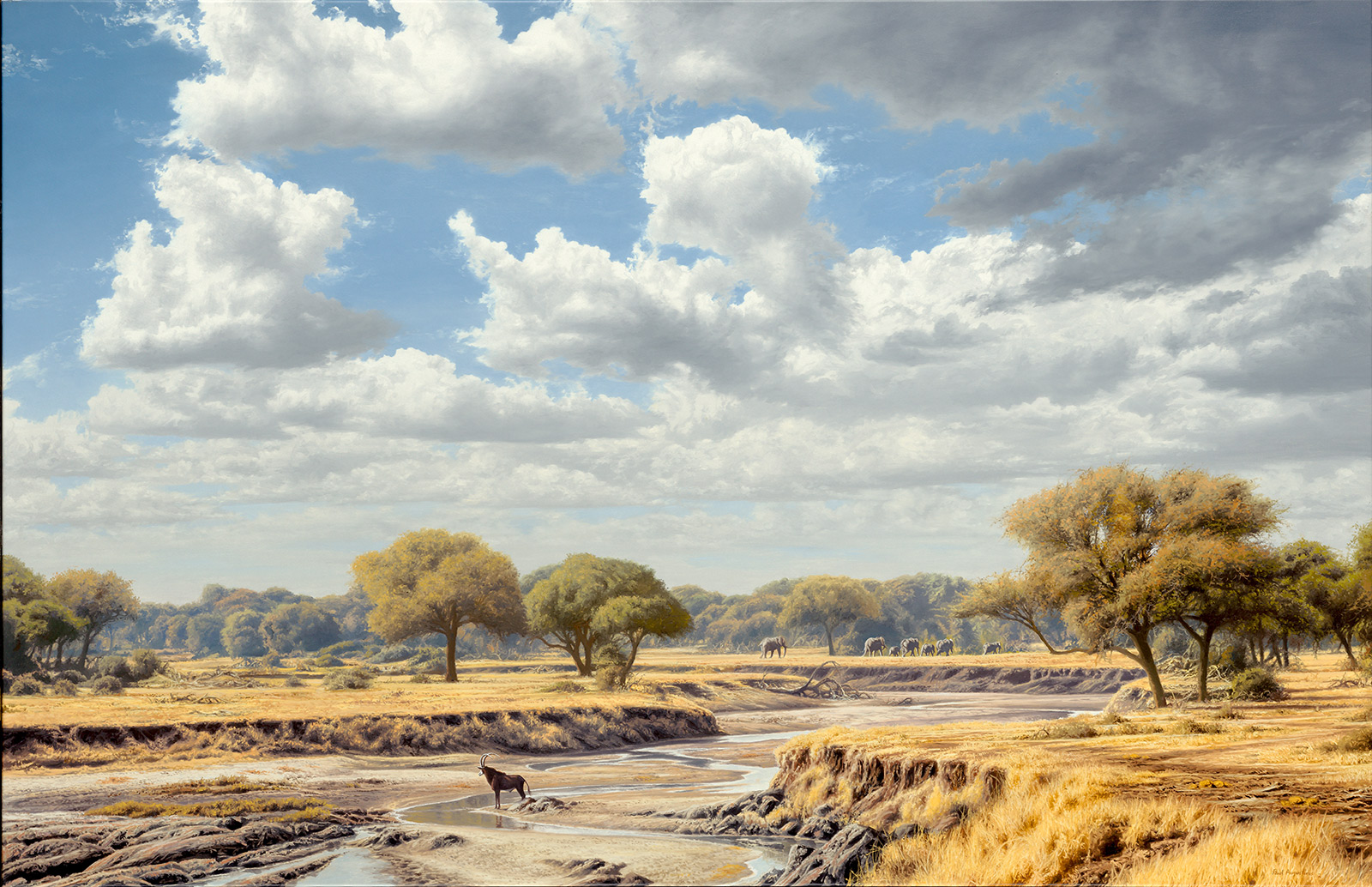
ARTIST: Paul Augustinus
TITLE: The Ngwezumba River
SIZE: 117cm x 181cm
Oil on Canvas
'I first visited the Ngwezumba area in August 1978 on the basis of a conversation I had several months earlier with Pat Carr-Hartley, a good friend in Kasane, Botswana. He conducted safaris in several vast concessions bordering the Ngwezumba area. Over lunch on one of my visits to his Kasane home which overlooked the Chobe River in Botswana, he told me that there was a rarely visited river valley one hundred kilometers to the south of the Chobe river that had huge concentrations of wildlife during the late dry season. “The Game Department hasn’t had a presence down there for years now and it’s real bushwhacking country! “ he assured me. The only way to access the area was a two-day journey along a rough track through wild country which a decade earlier had been the only direct route between Kasane and Maun on the edge of the Okavango. When a much better road to Maun was built in the early 1970s, using a route through the Kachikau Salient to the west of the National Park, the Ngwezumba track ceased to be used and a vast area of the Chobe, through which it passed, then slipped into blissful obscurity for many years. In August 1978 it took me two full days to get to the Ngwezumba from Savuti on that old route which, although still usable, had rapidly become very overgrown. My Landcruiser was heavily loaded with art materials (including an easel!), provisions, spare parts, camping gear and five hundred liters of fuel, all of the paraphernalia needed for a month long stay. So it was a slow journey characterized by the whine of a transfer case in low gear, creaking leaf springs and an engine temperature gauge whose needle hovered close to the red zone! The journey was made even slower still by long stretches where elephants had pushed trees over and onto the track and a detour was needed round each one. The first night was spent camped in the white sand bed of the Ngwezumba where it entered the Mababe Depression, and by noon the following day I was approaching the first pools of the upper Ngwezumba River. I had arrived!'
.