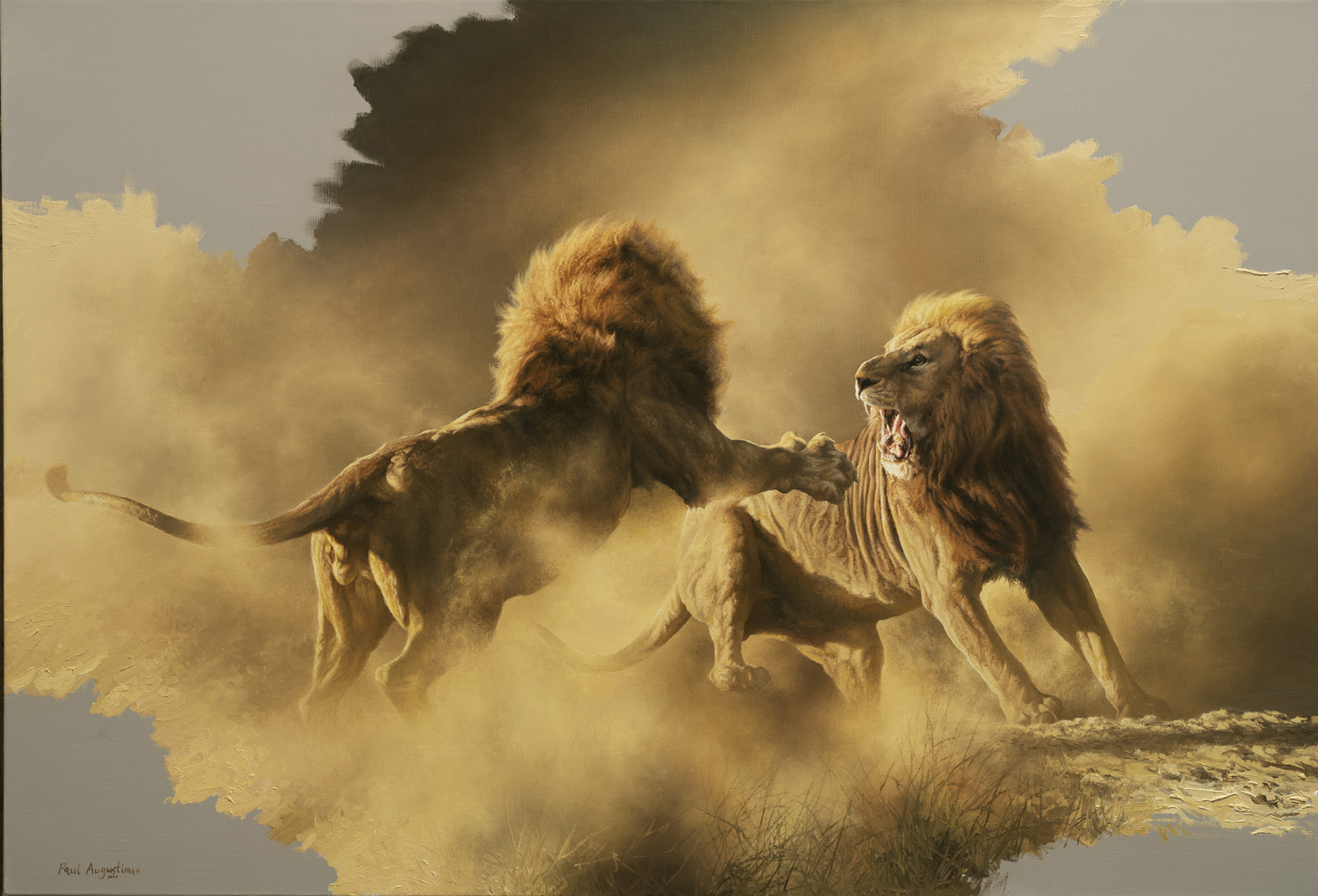
Over the last four decades I have spent nearly 15 continuous years in the field. It was an adventure for me and my wife and fun too, because I was living the dream of being free to roam in the last bastions of true wilderness in Africa. But I was also gathering material for paintings. One thing I learned early on was that it was difficult to be in the right place at the right time. That meant that I had to rise before dawn and be out searching for something interesting because the most atmospheric light lasted only for a couple of hours after dawn. Then it was back to wherever I was camped. The middle of the day was spent fixing punctures, eating, washing and then lying around and enduring the burning heat of the day. Which is what wild animals are doing also! Then I was out again at 4pm and stayed out until it was sunset, the second period of the day when the light was just right. I was always after moody, low angle , atmospheric lighting because in that light even the ugliest tree will look beautiful. So there was a limited amount of time each day that was useful and you had to see whatever it was that you were looking for in that limited span of the day. You have to spend years in the bush to see exceptionally interesting, compelling wildlife and landscape moments that might end up as paintings. This particularly applies to the cats. They are difficult to find anyway but to see them doing something interesting in perfect light is statistically difficult. Lions are commonly seen wandering along in the morning or lying under a bush in the evening, or even stalking wildlife. But these lions have been active all night and are usually winding their activities down when tourists arrive. I have never stopped to look at lions sleeping under a bush - I consider watching lions resting under a bush to more boring than watching paint dry. Nothing happens! But lion territorial fights are different - the lions are very active, alert, tensed up, heads cocked, muscles bulging and straining in a way that on does not see most of the time. In fifteen continuous years out in the wild, I have only been lucky enough to see five territorial lion fights. One of those occasions happened almost too quickly for me to absorb what I was seeing. On two occasions the fights were short but useful to me. And two other occasions the fight went on for more than an hour and I was able to maked dozens and dozens of sketches and take several rolls of film. Those five encounters have provided me with the source material for most of the lion paintings I have produced and now also for the new series of lion paintings I am working on. It took a huge amount of time in the bush, endless driving along bad roads, endless hours of searching for lions, endlessly trying to be in the right place at just the right time. It took all of that time and effort to experience those five special encounters.
The locations of the five lion fights were 1) Near the Kitani bandas in Tsavo. 2) In the Rift valley, below the Oloolo Escarpment. 3) On the Santawani floodplain, in the western part of the Okavango. 4) Kwekampa Pan, in the Ngwezumba area of the Chobe National Park. 5) Within sight of Thomas Baines baobabs in the Kudiakam Pan area of Botswana.
.