REFUGIA SERIES*
ARTIST: Paul Augustinus
TITLE: Zambezi Valley, Sapi area
SIZE: 117 cm x 180 cm
Oil on Canvas

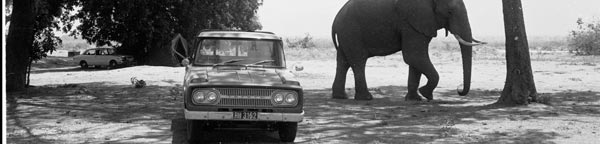
I have know the Zambezi Valley since 1965. When I was 15 years old my mother drove me down to the Mana Pools Game Reserve. It was a 1967 school holiday and we camped there for a whole month. Before we departed on this important safari I bought an old standard-gauge 8mm Bolex movie camera and a dozen Kodak Standard 8 Kodachrome KII 25 foot rolls from Clintons camera shop in downtown Salisbury. My mother hired a pickup, bought a whole load of camping gear, a fuel drum and six weeks supply of food and drink and we departed for the Zambezi Valley as soon as school broke up for the holidays. This was the longest time I had ever spent in the bush! More importantly it was also a safari with a very specific purpose. I had a grand plan that involved writing, photography and art. I wanted to make a 8mm home-movie documentary of my experience at Mana Pools to illustrate a Geography project at my school (Prince Edward.)It was a very ambitious effort - a home movie, combined with an art show and a small booklet which I typed up using my mothers typewriter, and then stapled together. So this Mana trip became my very first working safari! Mana, Sapi, Nyakasanga, Urungwe, Kariba and Chewore were the names of the various wildlife sectors the Zambezi Valley below the escarpment. The Zambezi Valley, its gigantic river, escarpments and floodplain forests remains one of the most iconic wilderness landscapes in all of Africa. Most of my school holidays were spent on camping trips here when it was still a Game Reserve. I continued to visit regularly when I lived in the Chobe District of Botswana in the 1970s, 80s and 90s.
Mana Pools was still just a simple Game Reserve and had not yet been gazetted as a National Park. It lay undisturbed in a vast, steaming-hot corner of the lower Zambezi Valley and was inhabited by thousands of black rhino and belts of tsetse flies. Best of all travelers were not constrained by silly rules that ruined the wilderness experience. Driving off road was not frowned on and you could walk anywhere you wanted. We also spent several days to the east of Mana - at the smaller but equally beautiful Sapi Floodplains, staying at the camp of a schoolfriend whose father was on safari there at the same time as we were in the Valley.
I intended to record these wilderness locations for posterity (!!!) and most importantly to explain why I thought that rules would ruin Africa's last remaining wilderness areas - a subject I was very passionate about. Most of the parties one came across camped at Mana back then were Mashonaland farmers on their annual holiday in the bush. We were always careful to camp well away from them because instead of game watching they were more interested in grilling meat, drinking beer and fishing for tiger and bream in the Zambezi River, something they did on an almost industrial scale. They also seemed to delight in burping loudly late into the night. My mother was horrified. Over the course of the next four weeks I exposed 24 minutes of Kodachrome film on my movie camera as well as several rolls of Kodachrome slide film on my prized Miranda Sensorex SLR. I also made three oil paintings on canvas board, numerous pencil sketches and created several detailed maps. Back home I used these to illustrate my project and this was so liked by the Geography teacher that my next school report card was filled with glowing compliments - although my classmates never really understood what I was trying to say about the evilness of "rules!"
For an article and images about those school holidays to the Zambezi Valley in the 1960s click HERE.
.
.
